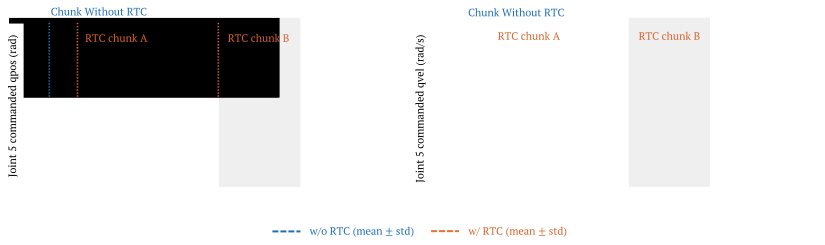
We examine how RTC affects chunk transitions using real-world Ball Push rollouts of VIPER with and without RTC. The figure shows commanded position and velocity for joint 5 of the right arm, with mean and standard deviation over 50 episodes per setting, aligned at episode start. The plot covers the first baseline chunk (0–0.8 s), before contact with the ball; RTC switches chunks at 0.06, 0.38, and 0.70 s.
At the transition between RTC chunks A and B, position remains continuous, but velocity drops from approximately 0.35 to 0.2 rad/s within the blend window and recovers only to 0.5 rad/s by the end of the window. Without RTC, velocity rises steadily from approximately 0.45 to 0.7 rad/s over the same interval.
This pre-contact observation suggests that position-based inpainting alone does not ensure velocity continuity across chunks, although it does not directly establish an effect on contact velocity or task success. A potential extension is to constrain the committed position and velocity prefixes jointly during inpainting; we leave evaluation of this extension to future work.